Gesture Figure Drawing Lesson Plan
Blog
In The Classroom - Expressive Effigy Drawing
How can effigy cartoon be adjusted to benefit cartooning in the classroom?
Figure drawing is a well-known art exercise for students of all ages, and can be approached in many different ways. The excitement and joy of cartooning is non the precision of cartoon, simply the communication through marks and forms. Therefore, my approach to figure drawing with my students is not about capturing the perfect form, merely instead capturing the emotion that the effigy is conveying.
Below is a lesson plan I developed for two different high school classrooms: an advanced drawing + painting class, and a beginner'southward drawing class. Students were grades x - 12, but I take done similar group activities with unproblematic and middle form students, who also enjoy the challenge.

Work by 12th grade educatee.
Lesson Program
Concept
Drawing can communicate sensations, feelings or ideas to someone else. Cartoon describes new understandings of the human experience.
Assignments
-
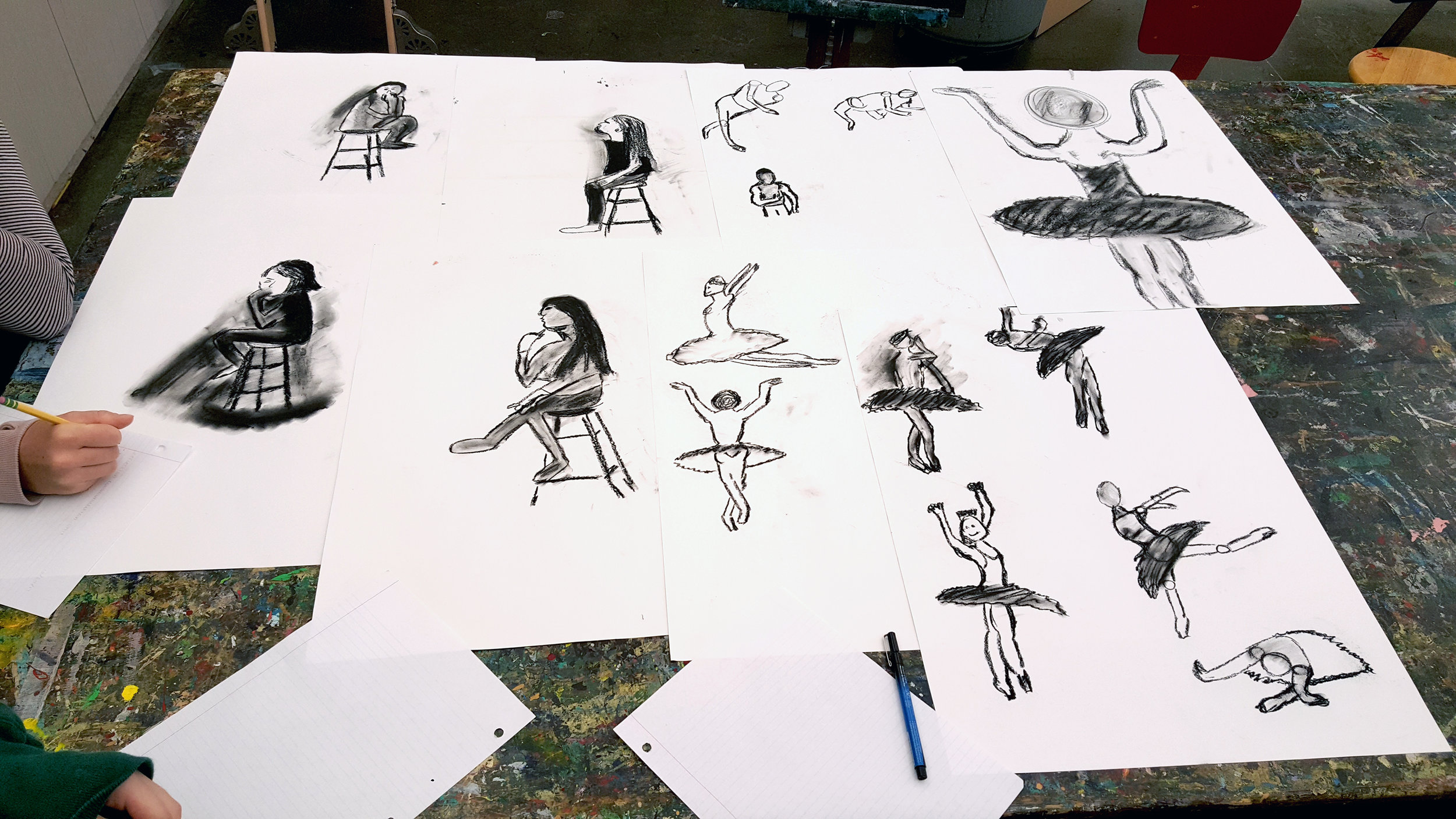
Assignment 1: Dancers + Ballerinas
-
Assignment 2: Pupil Emotions
-
Assignment 3: 30 Infinitesimal Pose
References
-
Kathe Kollwitz
-
Edvard Munch
-
Jillian Tamaki
Learning Outcomes and Objectives
-
Develop different drawn marker-making techniques and approaches.
-
Utilise drawing as a symbolic linguistic communication to think and understand the earth.
-
Utilize drawing to communicate emotions and form.
-
Compare and empathise ane'due south own interpretation of a work of art with the interpretation of others.
Materials
-
Charcoal
-
Pencils
-
Drawing Paper
-
Cartoon Boards
-
Easels
Vocabulary:
-
Impressionism: a 19th-century fine art motion characterized by relatively modest, thin, all the same visible castor strokes, open composition, accent on accurate depiction of light in its irresolute qualities (often accentuating the effects of the passage of time), ordinary subject field matter, inclusion of motility as a crucial element of homo perception and experience, and unusual visual angles.
-
Expressionism: from the commencement of the 20th century, to present the world solely from a subjective perspective, distorting information technology radically for emotional effect in guild to evoke moods or ideas. Expressionist artists sought to express the pregnant of emotional experience rather than concrete reality.
-
Dynamic: having or showing a lot of energy // of or relating to energy, move, or physical force
-
Gesture Drawing: A gesture drawing is a laying in of the activity, form, and pose of a model/effigy. Typical situations involve an artist drawing a serial of poses taken past a model in a short amount of fourth dimension, often as little as 10 seconds, or as long as 5 minutes.
Learning Program
References
Before beginning assignments, nosotros look as a course at a slideshow of image references. My slideshow consists of work by Kathe Kollwitz,Edvard Munch and Jillian Tamaki. I feel it is important to share drawing work when in a drawing course, as much as the temptation may strike to share other media types. (I fudge this stipulation slightly with some lithography work, which still contains marks originally fabricated by cartoon on stone.) We then hash out the references:What are the subjects in the image feeling? How did the artist used visual language to convey that feeling?
Consignment i: Dancers + Ballerinas

Piece of work by 11th grade student.
Introduction:To introduce students to the idea of expressive + emotional figures, we begin by watching various trip the light fantastic toe videos. Some favorites are India Bussey performing an interpretive trip the light fantastic to "Blackness Butterfly", and Uliana Lopatkina dancing the Dying Swan from Swan Lake. Nosotros and then hash out emotions through body movement:What emotions exercise you think the dancers were trying to convey with their body?
Exercise:Experiment in mark-making while watching the dancers. While re-watching the videos, students use observational drawing to describe the dancers' emotions. Focus should be placed on development of mark.
Discussion and sharing of techniques and choices: How hard or soft are you pressing? How big or small are your marks? Are you smudging or using value in your marks? How does the type of marker you apply express the emotion of the dancer?
Assignment 2: Student Emotions

Work by 11th class educatee.
Individual students will pose for the residual of the class in curt intervals. The model will choose an emotion and pose to communicate the feeling.
-
Inspiration for poses may be fatigued from the trip the light fantastic videos, or any other personal or observed feel the student has had.
-
The pose is held by the student a maximum of five minutes, or for more complicated and physically taxing poses, less time is fine.
With charcoal, the class will create an observational drawing of the model using marks, shapes and shadow to capture the figure with a visual linguistic communication that communicates the emotion.
-
Gesture drawing may be used past the students to capture the figure in a short amount of time.
-
Recalling the drawing experiment with the trip the light fantastic videos, students should explore symbolic marker-making to convey the model'due south emotional prompt.
Assignment 3: 30 Infinitesimal Pose
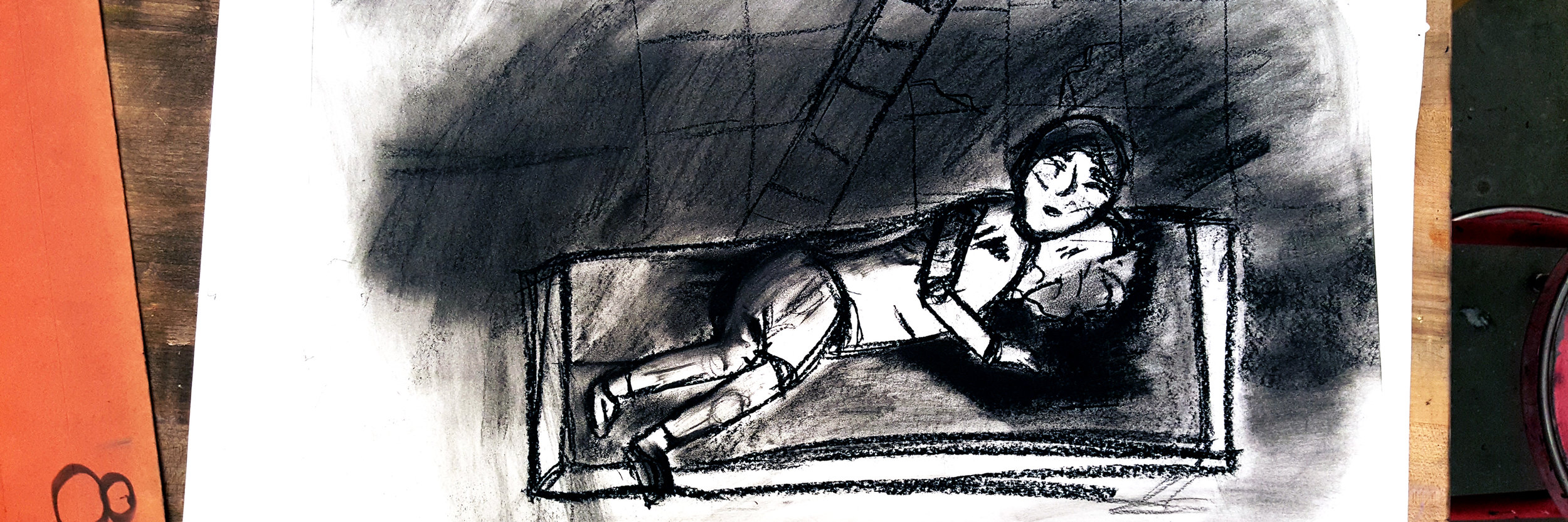
Work past 10th grade educatee.
We ended our figure cartoon unit by inviting some other pupil with a free menses to pose for the states in a reclaimed position for thirty minutes. This opportunity gave students the take a chance to slow down their process even further, and capture the figure with deliberate marks. Having a pupil from outside the class fabricated this easier, since no fine art student would then lose 30 minutes of their class!
Once more, students were asked not to focus on perfection, just on expression and emotion.Final drawings are below, which show the exciting range of figure drawing students were able to achieve in this lesson. By removing the thought of realism, students were able to be freer in their personal expression.
Conclusion
Figure cartoon tin be used for more than than learning how to describe the figure with perfection and ascertainment.Past exploring the emotional expression of bodies by observing and watching dancers, students are prepared to explore and push the boundaries of what would unremarkably exist expected of a figure drawing course. Grade participation adds an chemical element of fun and humor, and a longer pose at the end allows students to utilize all the personal mark-making they adult into a final piece.
Effigy drawing is a great add-on to cartooning in the classroom!It allows educatee to explore how figures and the marks used to depict them can communicate emotion. With the right grooming, figure drawing tin be extremely fun and freeing!
ortegaoripsensfuld.blogspot.com
Source: https://comicarted.com/blog/2018/1/17/in-the-classroom-expressive-figure-drawing
0 Response to "Gesture Figure Drawing Lesson Plan"
Post a Comment